Grand Slam
The registration platform behind Taekwondo Grand Slam. Clubs keep one roster and enter it into any competition; a matching engine places every athlete in exactly one of 567 divisions, and organisers export the whole event in one click.
- Role
- Solo · design + build
- Year
- 2026
- Category
- Product
- Weight
- 1kg
- Price
- Reserve
- Roast
- 5/5
- Notes
- Roster-first · Bilingual · Built for the rush
- Stack
- React 19 · Hono · Cloudflare Workers · D1 · Drizzle
The origin
Before this, every tournament started from a blank page — coaches retyping their whole roster, athlete by athlete, each time they entered an event. I wanted the opposite. A club keeps one living roster of its players and coaches, and enters that same roster into as many competitions as it likes. Change a phone number or a belt once and it updates everywhere. But the moment you submit an entry, that entry locks to exactly what you sent — belt, weight, and events fixed in place — so the roster stays yours to keep tidy while each registration remains a faithful record of what was actually entered.
The pull
Registration is where it gets real. A captain opens a competition and every division is a filter away — no cross-referencing a PDF, no guessing which bracket an athlete belongs in. The hard part, invisible when it works, is that the app never decides a division by reading a label: it matches each athlete on gender, age, belt, and weight, and the weight bands are drawn so no two brackets overlap and everyone lands in exactly one. Drafts save as you go, every screen is bilingual with Traditional Chinese first, and organisers get their own side to run the event.
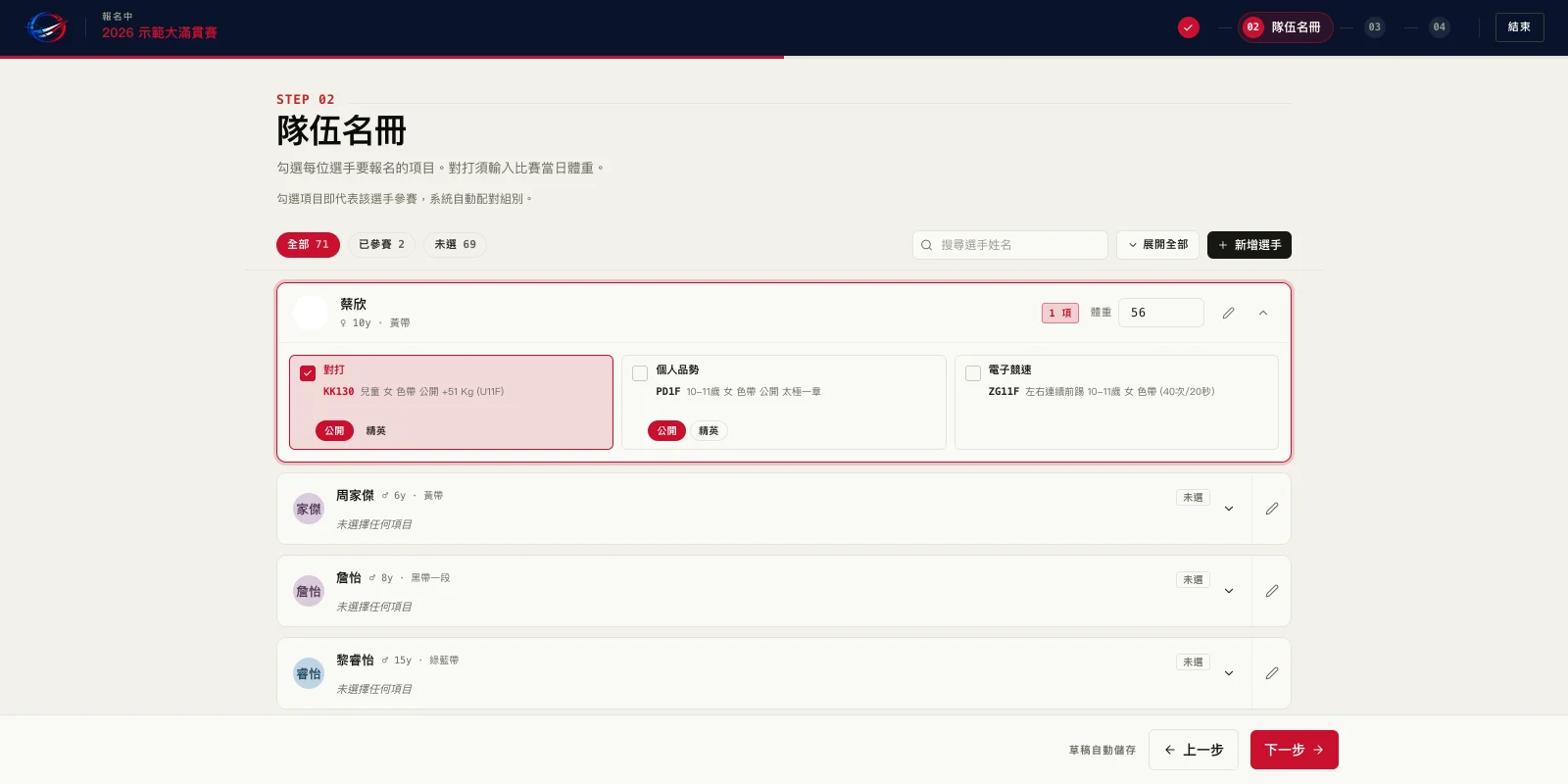
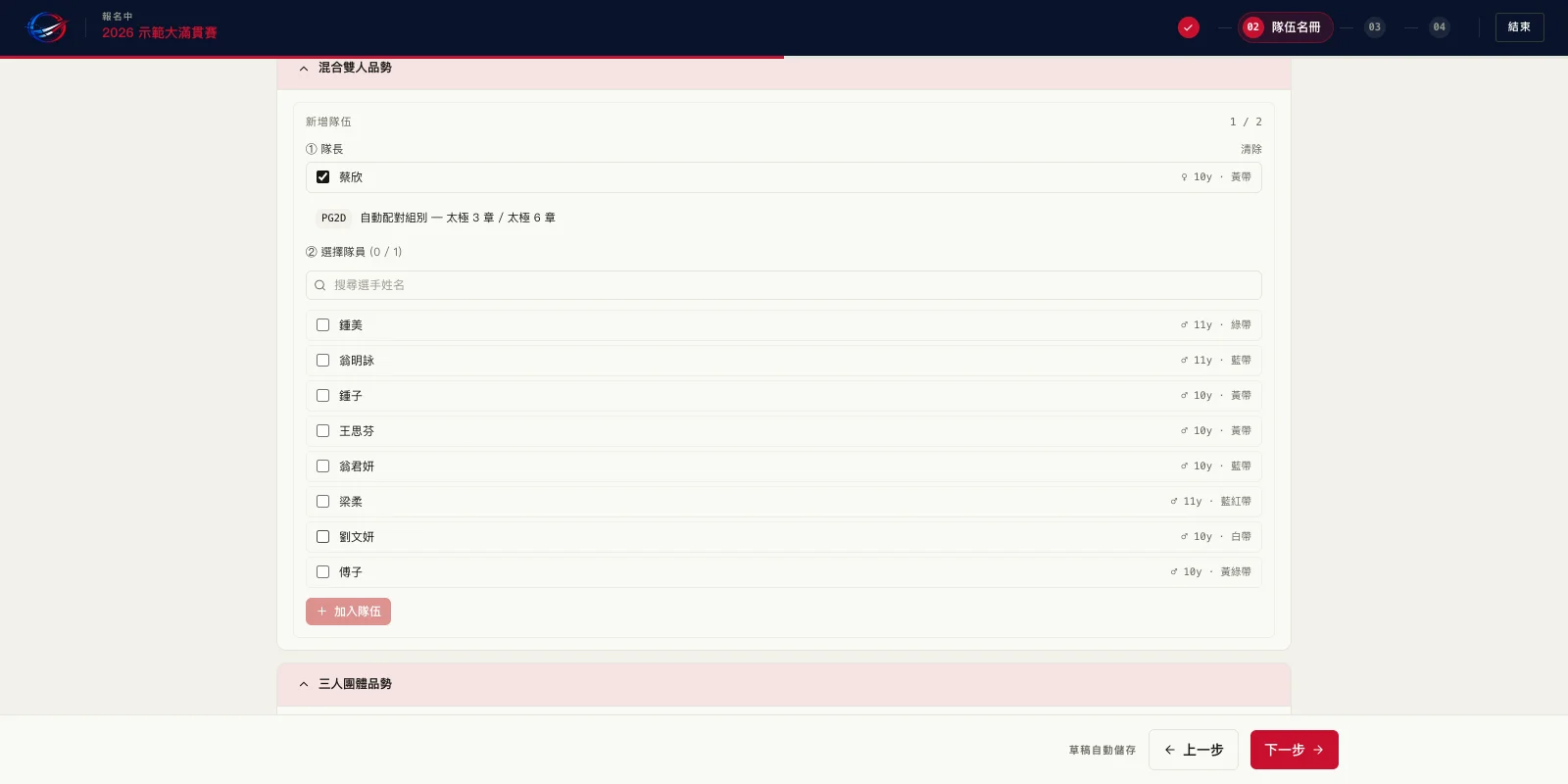
Step two is where the matching engine shows its hand. The roster becomes a grid — every athlete crossed with every event — and each cell already knows the answer before anyone ticks it: the exact bracket that athlete would land in, or the precise reason they can't enter. Where a bracket comes in open and elite tiers, the choice sits right in the cell. Team events start from an anchor: pick the team's lead, the app resolves the division, then only offers teammates who legally fit it — a mixed pair can only ever be one boy and one girl.
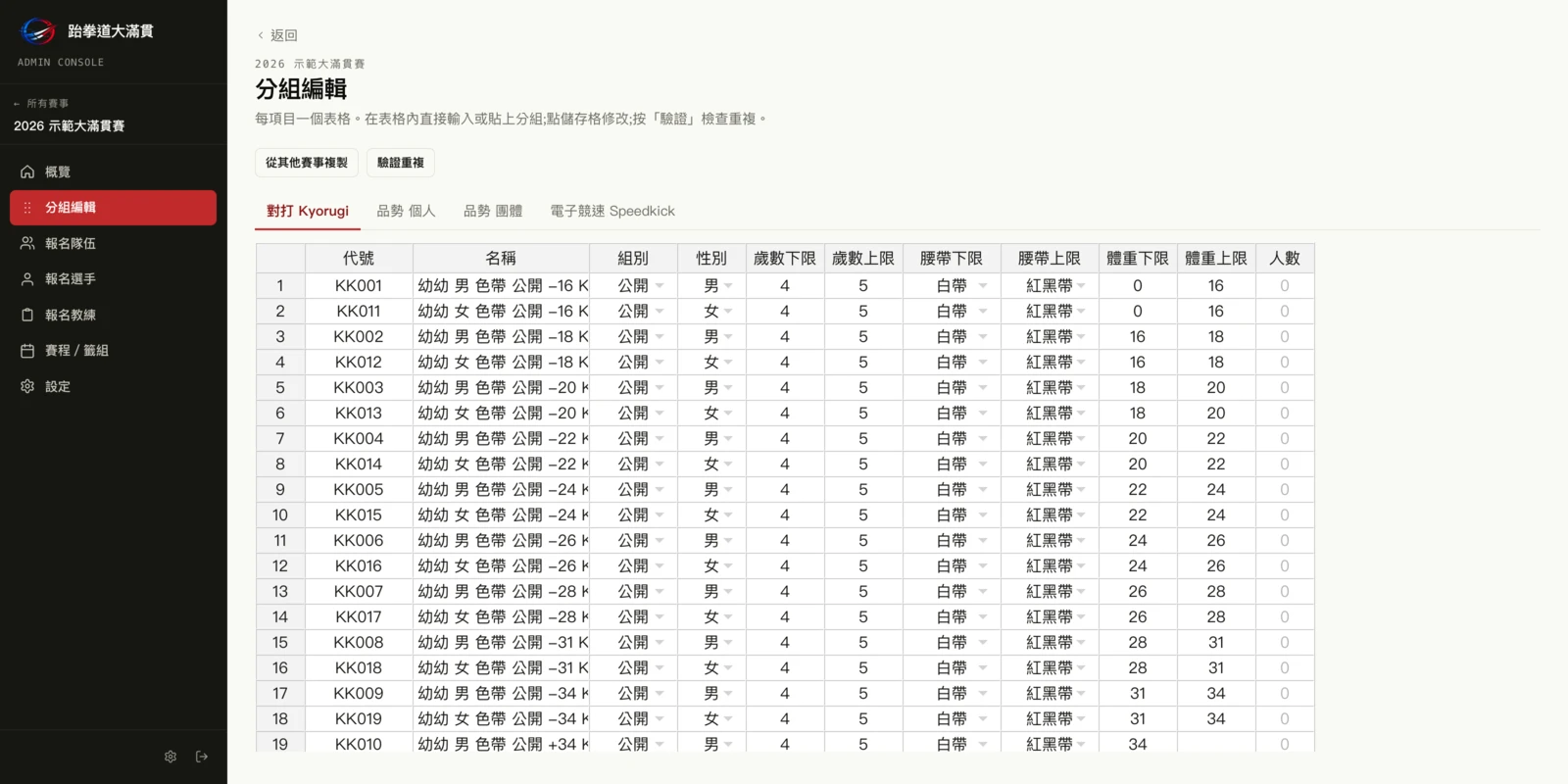
The organiser console had to survive a 567-division codebook. Divisions are authored in a real spreadsheet — typed or pasted straight from Excel, cloned from last year in one click — and a validator hunts down any two brackets a single athlete could match at once. If the codebook shifts mid-season, one re-match button re-runs the engine over every confirmed entry. In event week the whole event leaves as four downloads: player, coach, and draw-sheet spreadsheets, plus a zip that streams every ID photo out of storage, each file named to match the sheets.
What came out
Live in production · 567-division flagship event · bilingual captain + admin portals · event-week exports in one click